

Birthright Israel Volunteer mission

Updated: Mar 10
12 – 21 January 2026 by Alex Kats, participant from Melbourne

Departure / Day 1 – Monday 12 / Tuesday 13 January
For many years I had thought that the opportunity to participate in a Birthright program to Israel had passed me by. After all, Birthright had strict rules about age limits and previous Israel experiences, and I was now older and in the fortunate position to have been to Israel numerous times. But then after October 7 the world changed for Jewish communities everywhere, and organisations like Birthright had to adapt as well. One of their innovations in recent years was to change the nature of the programs. Whilst the regular Birthright touring program for under 26 year olds still exists, Birthright now offers volunteering programs for people older and those that have previously been to Israel – though maybe not within the last year or since October 7. The upshot is that after thinking I would never be able to go on such a program, I now find myself at the airport about to join a 10-day volunteering and solidarity trip with a group of fellow Aussies in their 30s to 50s, most of whom I have never met.

Whilst some things change, others stay the same. One of Birthright’s remaining rules is that participants need to get to the airport four hours in advance of their flights. Personally, I have never arrived at the airport that far ahead of a flight, but I followed the rule and arrived before the check-in counter even opened. And so did most of the rest of the contingent. It took just a few minutes but soon enough we all found each other and started to chat. Seemingly within moments we also started to bond. It is very likely that the four hour rule imposed by Birthright is because historically most of the groups were younger, first time travellers and North American, and getting to the airport super early for such groups makes sense. For us though, it seemed unnecessarily early and before anything, our first utterances as a group were words of complaint. That however dissipated very quickly as we started to bond, interact and get to know each other. And thus maybe the four hour rule was a maniacally genius way on the part of the organisers designed specifically for that purpose, because before we even got on the plane in Melbourne, we knew most people’s names, we knew where they came from and we knew who were the organised ones and who were the ones prone to more chaos in their lives.
As scheduled, after a long flight to Abu Dhabi and a short transfer at a busy, modern airport, our flight landed on time, just before 6am at Ben Gurion. The plan at

that stage, which had been communicated to us enroute, was that by 6:30 or so we would be on our way to our first destination up north. But on arrival, after meeting our guide, we discovered that the plan had changed and realised very quickly that even confirmed plans in Israel don’t necessarily happen as anticipated, until they actually happen. Instead of leaving straight away, we would now be waiting at the airport for at least a few hours for one more participant who was arriving on a different, later flight. This was of course frustrating and inconvenient, and some of us thought about leaving the airport, but given the early hour and the heavy rain, we thought better of it. Instead, though most of us went for some short walks around the terminal, we mostly spent the time further getting to know each other and exchanging detail-filled and very personal stories with people who were strangers mere hours earlier. We discovered that
one within our group was already a grandmother, three had never been to Israel before, a few could speak Hebrew almost fluently, many were parents leaving kids at home, many were of South African or Russian descent, most of us within the group had just one or two degrees of separation, and everyone was excited and uninhibited to share and interact. But as I observed this, I thought that maybe this delay – although it seemed somewhat spontaneous and unplanned – had actually come from the twisted recesses of someone’s mind, designed intentionally for us to be as familiar with each other as possible before the program even began... And it worked, except of course for the one for whom we were waiting, and one more who was due to arrive later. But it didn’t take long for them to feel part of our group too.
-----
There is something about the human condition that necessitates bonding. People often struggle when they are on their own and look out for others who are like them. This seems to be especially true for Jews, and even more so in Israel. After a few hours of driving, with a stop for lunch at a shopping centre somewhere in Israel’s northern heartland, we ended up in the town of Shlomi, essentially on the Lebanon border. Our first volunteering activity was to assist a community organisation that helps schools and communities by teaching them life skills like gardening, woodworking, sewing and other creative pursuits, and our duty was to help them build some benches and varnish some other pieces of wood, ready for a future project. The people who do this on a regular basis are post-high school teens who spend a few months in such communities ahead of their conscripted army service. The building task made us feel like we were contributing something tangible to their community, but the interactions with the teens made the experience so much more enriching. They told us about their lives, dreams and expectations, and about life in the north of Israel, and the challenges that come with it. Before we left, we felt a bond – the kind that one normally doesn’t feel when meeting teens for the first time. Was it because they were Jewish or in Israel, or was it on some other metaphysical level? Many of us even exchanged Instagram handles and added them on Facebook or WhatsApp – these people that in all honestly we are never likely to meet again.

And that sense of familiarity with strangers was the continuing theme of our first day. Between the end of the activity and dinner, a few of us went to the local minimart to look around a buy a few supplies. But on the way, one of the guys within our group asked for directions from a local, and within minutes the two of them began a conversation about life and family. This neighbourly stranger from this small town in Israel’s north then invited the three of us to his home for a drink. I felt a little reluctant but went along anyway, constantly thinking that this is not the kind of thing I could imagine doing anywhere else in the world. The guy brought in three unfamiliar Aussies into his home and introduced us to his girlfriend, who not only didn’t wince about strangers in her living room, but proceeded to cut up veggies and put out snacks for us, whilst her partner poured drinks and encouraged conversation. We stayed only for thirty minutes, but left feeling like we had been enriched by this experience with these people who were no longer strangers.
Then after dinner on this very long first day, this sense of bonding with strangers continued. In the dining room of the hotel was a group of Brazilians on a similar program, and after our evening session, a few of us decided to chat over a few drinks in a side room before bed, to get to know each other even better, and on the way we saw four of the Brazilian girls and invited them to join us. They were on an equivalent program for the same age group and many of them had also only met at the airport a day earlier. Their English was superb and their willingness to share was just as enthusiastic as ours, so within just half an hour or so, we felt connected in a way that it is hard to imagine other random people from other cultures ever could be. In fact, It felt like we were all living in a parallel universe, with their lives and Jewish communities so similar to our own, just in Portuguese. If this was just the first day, I can only imagine how much more intense, engaging and engrossing the rest of the program will be.
Day 2 – Wednesday 14 January
After a long sleep that everyone not only needed but deserved, the second day of our program began at a Yeshuv (township) close to the Lebanon border, but further along the border from Shlomi and thus required an hour-long bus drive with more time for all of us to chat – though no longer as strangers; now as firm friends. Our activity for the day required more building work and some gardening for a small community that had

only returned half a year ago to their homes, after having been evacuated and living in temporary accommodation for close to 18 months. We joined another organisation that comes into such communities to help them get back on their feet, and their current project is to build and grow their community garden. We were building garden planter boxes and other equipment, and like the previous day, interacting with the locals was the highlight. Also, knowing that we had contributed in a small way to the lives of this somewhat remote and distant community made us all feel like it had been a worthwhile experience. On top of that, before leaving, since it was 14 January – exactly one month since the Bondi attack – we had a makeshift Israeli memorial ceremony with an Aussie twist. We lit candles, read out the names of the victims, had a talk by a

Sydneysider who was there and affected, and sang both the Israeli and Australian anthems. It was a five minute addition to our schedule but given the occasion, the setting and the burden that many of us are still carrying as a result of that incident, it was a very meaningful and special experience.
But that was only the first half of the day. The original plan was for us to return to Shlomi in the afternoon and to have free time in that quiet hamlet with nothing much to do. Some were thinking of going elsewhere in the north, but travelling on our own in unfamiliar locales close to the border of a hostile country did not entirely appeal. We already knew that plans are never quite confirmed until they actually occur, so after a bit of negotiation, haggling and even the prospect of bribery, we convinced our guide to get permission from her superiors to allow our group to spend the afternoon in Tzfat (Safed), an ancient, historic and supposedly spiritual town north of the Jordan River. It was a long drive there and even longer on the way back – with more time for bonding – but it allowed us all to explore this town that was never part of our itinerary. And what a town! I didn’t go to the cemetery or any of the synagogues like I did last time I was in town close to 30 years ago, so maybe that’s why I didn’t quite get the sense of spirituality that the

place is renowned for, but I think we all experienced the glorious history and natural beauty of the hillside and particularly the old city. It was a good prelude for Jerusalem, especially for the three Israel newbies amongst us, because in many ways, the city is reminiscent of the capital’s Old City. Both share narrow alleyways, shops buried in crevices that look too narrow, ancient and small to hold a modern retail facility, and both are full of people in search of holiness and something more. The city wasn’t quite as packed as might have been expected, but that is typical of the times in which we are living, especially in the north. The benefit of a

decrease in numbers meant that we almost had some of the streets to ourselves and were able to explore many parts of this small but packed and engrossing city. The pictures that we all shared with each other back on the bus were not only enchanting and beautiful given the colours and the light of the place, but they were also diverse and illuminating, showing the breadth of activities that people got up to in less than 90 minutes.
After dinner back in Shlomi, with nothing on the schedule and little else to do in this sleepy hollow in the evening, many of us went to the one and only shop within walking distance of our hotel – the small but expansive minimart that a few of us had visited the previous evening. Most of us only bought a handful of items, but we stayed there for 30 minutes or so and explored almost every item. Some looked almost exactly like items at home but with Hebrew lettering, whilst others were very niche and specific to Israel. The overwhelming sound in that store for that half hour was one of laughter, and one person even quipped that at our age and for some of us, hanging out in a supermarket on a

weeknight constitutes an outing. Although what she actually said was that this was a good outing given that we are now in our middle ages (rather than middle aged). From that point on, her nickname, for at least a couple of days, became ‘Middle Ages’. For another within our group, it was more than just an outing. He had already established himself as the father of the group (despite not being the oldest) and in some photos, because of the way he stands, he has the demeanour of a protective figure. Early on he befriended the youngest in our group, and together they became known as the kid and the bodyguard. That kind of shorthand was only possible because of the immediate bonds that had already been created. At the shop, our father figure bought two bags full of items like chips, chocolates and other sweets, and then invited all of us to a room in the hotel for his so-called sponsored Kiddush, where we ate, chatted, listened to music and played some games, from Hangman to broken telephone. They were childhood games and it was reminiscent of a school camp experience, but one that continued our bonding process and added to the overall experience of our group. If this was only the second day, by the end of the week it will be hard to extricate ourselves from the country that we love and the people that we now feel so connected to as well.
Day 3 – Thursday 15 January
Most of our days on this program are in two halves. We have a volunteering activity as a group for one part of the day and our own time for the other part of the day. At least that’s the theory. But given the nature of our group and the deep bonds that we have now developed, the time on our own is rarely by ourselves; we generally go out as a group. Thursday began at a hamlet an hour or so outside of Jerusalem called Chasdei Enosh, which supports religious Jewish men with disabilities, most of whom have various forms of debilitating mental illness. On the drive there, through some hills and potted roads, one from our group took to the microphone and asked ‘why is there always enough asphalt for speed bumps but never enough to fill in the pot holes?’ This made us

all laugh and is something I still think about now.
At the site we met the director of the enterprise, who in broken but very competent English, told us about their work overcoming stigma and providing dignity to the people in their care by empowering them with jobs. Most of the wok is menial and mind numbing to some extent, in factories or warehouses around the site, but for people who struggle to get out of bed or have other mental demons, it is the kind of work that makes them feel empowered and ennobled. Our task was to make some of the hampers to assist with the efficiency of their production process, and given the connections that our group had made and even the shorthand familiarity that we had now developed, we were even more efficient than Aviv had anticipated. So much so that we even made a bunch of empty boxes for the next group to use. It was a productive few hours that made us feel like we had genuinely contributed to a worthy organisation serving some of Israel’s most vulnerable.
But that was just the first part of the day. From Chasdei Enosh we finally made

our way to Jerusalem – a city of great anticipation and exhilaration for many, and especially so for those who are here for the first time. As such, after checking in to the hotel, we decided on our own to do a tour of the city, including the Old City and the Kotel. We met at the lobby of the hotel and nearly three quarters of our group then walked around the corner to the central station, took the light rail up Jaffa St and got off at the City Hall stop, which is the closest to the Jaffa Gate. Already at the point, before even entering through the gate, if a stranger had joined our group, they would have been able to tell who were the first time visitors, such were the expressions on their faces. Although that is not entirely accurate because everyone was excited and energised at that point. Even for those who had been to Israel many times, no visit is ever complete until you come to Jerusalem and specifically to the Old City. And it was very clear we were in Jerusalem. Just minutes after leaving the hotel, not only did the streets start to look familiar, but we also started to recognise people from Australia. We met our first Aussie in the lobby of

the hotel, another before we got on the tram and many more as the night progressed. One person within our group predicted that we would see six Aussies before we split up, and she was spot on, but before the night was out, I had seen at least half a dozen more, and that is only the people whose names I knew, not their friends or others who they were with.
Personally, I’ve lived in the capital on several occasions and was last in town three years ago, but there is nothing like coming back and entering the Old City with people who had never been there before – an experience I have had a number of times before. We thus entered quite quickly since some had dinner plans to get to, but slow enough to take it in, and with purpose. I hadn’t been there for 3 years, but I directed the group and navigated our way through the quarters and especially the Jewish quarter, down to the Western Wall itself. Once we got to the plaza, there was a visible sense of quiet introspection that fell over most people’s faces. We spent maybe just 20 minutes at the Wall, but for everyone and especially for the first timers, it was a special experience, maybe even a spiritual one. I asked some of those experiencing it for the first time how they felt, and each of them said it was more holy, more enlightening and more dynamic than they had expected. One of the things that moved everyone and inspired a lot of discussion was the Muslim call to prayer, which sounded just as we began to leave. I personally find it a somewhat soothing sound, but hearing it was jarring for so many within our group. After all, there is never a call to Jewish prayer that is broadcast even within the Jewish neighbourhoods, so why is the Muslim call so audible and prominent?
We left the Old City the way we entered and made our way to Machane Yehuda – the Shuk (market). That is where the group split up and when I joined two others from our group to meet up with a mutual Aussie friend of ours who has lived in Israel for years. It was wonderful to catch up, to reminisce and to hear stories that only happen in Israel – from stories about the army, to stories about navigating Israeli bureaucracy. But we also heard about how Jewish life can be fully lived in this country, even amidst war, threats of war and terror. And it was just nice to catch up with all of us after all these years. Some of the discussions we had were over dinner on Ben Yehuda Street where we used to hang out all those years ago, but some were in the Shuk, where we ended up after and connected with much of the rest of our group. We very quickly realised that the Shuk is

party central on a Thursday night – a party that we were only too keen to embrace. It was a little hard to talk over the noise and the chaos, but it was also hard to look away. Some of the retail spaces were closed and in their place were makeshift nightclubs with people sitting and even standing on chairs or tables, bobbing along to the very loud Hebrew music that was emanating from the speakers. We left after a while and came into a quieter space where we saw more Aussies (including my niece) and which soon also became loud when a group of young Chabad guys entered the space with their flags and signs and started singing and dancing too. I don’t know when the place closed or when the majority started to disperse, but I do know that when we left after 11:30pm, it looked like some things were only just getting started. As we walked out, and later on reflection, we marvelled at how vibrant the scene was and how in that moment, despite constant and potential existential threats, it felt like the people at the Shuk didn’t have a care in the world, and maybe they didn’t, though for some no doubt, their carefree attitude masks a specific kind of vigilance and resilience that Israelis have in spades. And for the rest of us, it is maybe a lesson that we can learn too – that it is important to make the most of every moment.
Day 4/5 – Friday 16 / Shabbat 17 January
Every Friday is a unique day across Israel each week. For some, it is a day off, for some it is a work day though usually only a half day, and for some it is their busiest day of the week as they prepare for Shabbat. Even those who don’t keep Shabbat live the rhythm of the country and abide by the protocols that exist here. In our case, our organisers didn’t want us to lose a day, but given that Shabbat starts early in winter, we needed to be back in time for those of us who needed to go out, so that we would have time to get ready and depart. As such we left the hotel even slightly before 7am. For everyone it was early and especially for some of us who had partied a bit too hard the night before. About an hour later we arrived at a farming village called Givat Yesha’ayaho, not too far from Beit Shemesh. There we met a farmer named Yigal who told us about the land, the history and the farming prospects of the area. This particular patch has been in his family for decades and whilst there used to be animals and other plantations, currently there are only vines and his main business is selling grapes to a number of Israel’s

winemakers. Our task for the morning was to prune the vines, which was a monotonous and somewhat mind numbing job, but required a little bit of thought as we tried not to step into the mud, which covered the whole area as a result of recent rains. It was a slightly unavoidable thing to do and we all walked away with dirty, muddy shoes. I just hope the bus driver didn’t mind. As we worked, we looked around and reflected that although we were clearly in Israel with the Judean hills in the distance, this idyllic vineyard could have been almost anywhere in the world, and for a moment we even forgot we were even in this country, especially with the sun shining down and the air so quiet. After seeing how alive this country is the night before, our job, the atmosphere and the surrounds made us feel like we could have been anywhere, and without a care in the world. It made us feel even more prepared for our Shabbat experience.

After returning to Jerusalem, we all split up and everyone did their own thing. The original plan was that we would all do Shabbat dinner together and have a free day on Saturday in Jerusalem, but given most of us would only be here for one Shabbat, the majority wanted to visit family or friends, so we were essentially granted a free Shabbat... Except for six people from our group who didn’t have plans. They became known as the Shabbat Six, and after hearing what they did, particularly on Friday night, it is possible that they had the most spiritual experience of all of us, given that they had Shabbat dinner overlooking the Kotel with Jews from all over the world. For the rest of us, I think everyone had a great Shabbat experience, but not necessarily quite as spiritual or in quite a phenomenal setting.
As for me, I went to Modiin, a large town of over 120,000 residents in central Israel that distinguishes itself more than anything by the fact that it is almost midway between Jerusalem and Tel Aviv with easy access to trains and buses. I went there because I know a few families in town, and over the course of Shabbat I not only saw all three of them, but other Aussies as well. One of the couples I met specifically lives in town because she works in Tel Aviv and he works in Jerusalem, and that is typical of many. Most of the people I met – who are generally religious – also mentioned that another attraction of the town is that it is a mixed city, meaning that both religious and secular people live in town without any issues. Despite that, most of my friends live in the neighbourhoods that are generally classified as being modern orthodox, and though cars aren’t banned on Shabbat (like in some places in this country), it is accepted that most people don’t drive. In fact, some secular people specifically move into these parts of town because they like the quiet and lack of vehicles for 24 or 25 hours.
I had a very lovely Shabbat with great friends, good company, scrumptious food and comfortable accommodation. I also had some amazing experiences. After shule on Saturday morning, I had been told that there is a secret weekly Kiddush Club that moves around to different people’s homes each week. One only finds out the location an hour or so before Shabbat if one is on a specific WhatsApp group, but knowing that I would be in town, my friend who organises sent me the address, so my host and I walked to this week’s location. Almost immediately after entering, I heard my name being called in an American accent from across the room. A guy then proceeded to introduce himself and told me that he and I first met on an Israel program more than 20 years ago. I remembered the program but not him specifically, though as he talked he looked more and more familiar. He said that that program had had such a profound impact on him that several years later, he and has family moved to Israel and specifically to Modiin, especially because he wanted a religious life for his family. But as I left the kiddush, I couldn’t help but think that solely from the perspective of Jewish practice, life in this country is easier here than it is elsewhere. Obviously there are factors that make this country more complex and somewhat more dangerous than any other place on earth, but one doesn’t have to think as much about Jewish observance – most of the food is kosher, the country runs on the Jewish calendar and Shabbat is mandated a day off. That is the attraction for many, but is a actually a detraction for me. I want Judaism to be a bit more of a challenge.
Modiin is also probably not the first place I would consider living in if I ever came to this country on a more permanent basis. I need more noise, more hustle and bustle, and more traffic. There are parts of town that have that, even on Shabbat, but not where I stayed. Though even where I stayed, the noise and traffic returned just moments after Havdallah was made. And in fact, the chaos of the week also returned. Within an hour I had reunited with everyone I had met over Shabbat for photos, and had been deposited at the bus station, ready for my return journey back to Jerusalem. Back in the capital, after dropping my bag, I met one friend followed by another, and then close to 11pm, I joined the majority of our group back at the Shuk. The market wasn’t as packed as it had been on Thursday night and wasn’t quite as vibrant, but it was certainly pumping. The majority of the shops were closed, but in their place were tables and chairs filled with plates and glasses from the few bars that were open in the area. One was also playing

loud Israeli music, though I’m not sure who controlled the playlist. There was a mix of Israeli pop songs, loud Hebrew ballads, some Jewish prayers turned into songs, and even some musically inspired psalms. Some of it felt like music from a rock concert, whilst some of it could have been from a wedding. The area was filled mostly with young people, particularly religious boys, who bopped along to the music, and so did we, especially as the drinks kept coming. The overwhelming notion amongst our group was that all of it seemed surreal. Nowhere else could we imagine dancing, singing and drinking in a market late at night with a group in their early 20s next to us, and that the words that we were getting drunk to would be in Hebrew or from the Bible. We left after 1am, and though Sunday is a workday, it felt like the party would run for many more hours yet. For some it might have been normal, but for most of us, it was a ‘pinch-me’ moment that will fill our cup till next time we come back to this country.
Day 6 – Sunday 18 January
After the party the night before, it was nice to have a later start on Sunday. Some came into breakfast looking a little worse for wear, with the effects of the night before still clearly written on their faces. We even heard that one from our group spent part of the night vomiting, and more than once. For the first time since arriving in Jerusalem, we actually had time to enjoy the fullness of the Israeli breakfast, but as we got on the bus, someone said ‘I’ve eaten so much, the only thing that still fits me are my socks!’
Since we weren’t due to leave till after 10am, I had arranged to meet my second cousin – my one and only relative in Israel – in the lobby of our hotel at 9:30. For nearly 40 minutes I spoke to him in Hebrew, which was challenging and difficult but also somewhat exhilarating when I realised that I could have a conversation in this language and that we both understood each other. The most important thing I realised was to not be embarrassed to make a mistake, and I have never been the type to feel shame.
Our venue for Sunday was the campus of the ‘Shekel’ organisation in the suburbs of Tel Aviv, which is operated under the auspices of the Tel Aviv Foundation and the Ministry of Labour, Welfare and Social Services. Essentially it is a day centre for adults with various forms of disability, and our task was simply to hang out with the participants and to just be with them for a few hours. We were joined on this day by a handful of soldiers from the IDF Spokesperson’s Unit. Each Birthright group always has a

day when either soldiers or young Israelis join them, and these guys, who speak Hebrew and English, came to join us for this activity. Though even with military presence, the task for the day felt very disorganised and disjointed. We set up some sporting activities for them and helped them play, did some arts and crafts with them, and when the rain started, one of the most sociable of the residents connected her phone to the speaker system and initiated a dance party of Israeli songs, which changed the mood. Suddenly people who were quiet came out of their shells and started dancing, whilst others in wheelchairs also began dancing in their seats. A number from our group made special connections with some of the residents, and it was so gorgeous and lovely to watch them dance and bond. But as we left, I wondered if we actually achieved anything. Unlike other days, we didn’t make anything, we didn’t create anything, we didn’t produce anything. We simply spent time with the people, took a few hours away from their regular schedules and maybe made them smile. Some didn’t speak English and some don’t speak at all so communication was difficult, but ultimately for them, just a few hours with a group of people who came to care for them and to be with them undoubtedly made their day, and our guide said that they will talk about it for weeks. In that sense, we achieved more on this day than any other.
After the activity, we had a choice of what to do with the rest of our day. Some came back to Jerusalem on the bus whilst others stayed in Tel Aviv and made their own way back. I came back to the capital but somewhat regretted it when I saw the stunning photos that those who stayed sent to the group. The reason I came back was to meet a friend for dinner, and once back in Jerusalem, I took a bus to his place in the suburbs. Despite the darkness and partial rainfall, it was nice to drive through areas that I used to walk through and knew very well on previous occasions when I lived here. I then made my way back to the hotel by 8pm, and so did the Tel Aviv crew and everyone else, because we had a talk by Neil Lazarus, a well-known presenter and educator on matters related to Middle Eastern geopolitics. But we all walked back into the hotel a few minutes early, and as we got there, we saw a lobby full of people sitting at the tables set up around the lobby area. It took a second to realise who they all were and what was going on, but soon we discovered that all of them were ultra-religious couples of

‘Shidduch’ set-up dates. This is quite common across Israel (and other communities with ultra-religious Jews), where they come to a hotel lobby for their first dates because they want to be in a public environment that isn’t too intimate or intimidating, and this hotel is one of the popular destinations for such purposes. But for us it looked quite baffling and unexpected, and we spent a few minutes looking at the couples trying to foretell what they were saying and which of the couples would make it. I wondered what the hotel gets out of it, though we later found out that the staff on duty spend most of their shifts playing that game of imagination too, and maybe seeing these couples and watching them awkwardly interact with each other is enough of an attraction for the hotel and the staff.
A few minutes later we were in a room upstairs and Neil crammed a lot into 90

minutes, but presented it with humour and a very personable style that makes him such a seasoned presenter on these matters. Like often happens, he left us with more questions than answers, but also got us to think about the complexity of the region for ourselves. On multiple occasions he said that understanding doesn’t mean agreeing, and that multiple things can be true at once. One thing that stood out for me was when he asked a number of us to tell him the first global thing we remembered as kids. For some it was a major sporting event, the release of Nelson Mandela, the marriage or death of Princess Diana, September 11, or other such things. For Israelis, he said, almost all their earliest memories are of wars or terror events, and that these things stay with people for life. As such, he said that the world is made up of

either bystanders or history makers, and that as people of the book, it is our duty to either read or write the history we want to see in the world.
With the lecture over, most went to bed, but a few of us made our way into town to see an Aussie who some of us know, who plays in a local band. It was a small audience in a makeshift band room, but after the week we had already had and the experiences we had shared, it was nice to see life flourishing and people honing their skills. This is a land not just of contrasting dichotomies, but of polarising complexities, and yet somehow and in some strange way it not only works, but it enthrals, it engages, and it invites residents and visitors alike to embrace it all.
Day 7 – Monday 19 January
Today was the day that most of us looked forward to the most – if it is possible to look forward to a harrowing and traumatic experience. Today we were ready to go to ‘the south’, the catchall term that locals use to describe the areas in the Gaza envelope that were directly infiltrated and penetrated on October 7, 2023. For me and for many others

amongst us, this was the reason we came on this trip, and since that infamous date, a day of this nature has been included in every Birthright program.
We began our drive south at 7am, and since it was early and a long drive, the few people who pray each day decided to conduct their prayers on the bus. However, they only did part of their prayers in silence. Since it was Rosh Chodesh (the first day of a new Jewish month) with an additional prayer called Hallel, that is often very musical, they began singing the Hallel songs in unison, and most everyone joined in. For those that didn’t know the prayers, it was also a teaching moment, and a beautiful opportunity to share our tradition together.
Our first stop was Ashkelon, a city to the north of Gaza, about a two hour drive from Jerusalem. On the outskirts of town we entered the Balaban Farmhouse, though as we drove in, I wondered why we were going to a farm on this day. My expectation – and that of quite a few others, as I later discovered – was that this day would be devoted entirely to exploring the south and not volunteering. But once we arrived, we were greeted by Ronit, the farm owner who immediately made us feel very welcome. She told us that she used to have a farm in Gush Katif, a formerly Jewish town in the Gaza Strip, but has been at this site since the disengagement in 2005. She told us about the Thai workers who have been with her for many years, their loyalty post October 7, about how she set up this farm 20 years ago, and how it currently functions.

She also told us about her kids, told us that she was ‘sold out’ (a term she used to explain that she no longer had kids of marriageable age), and introduced us to Sagiv, her right-hand man and the guy who gave us our instructions. Some of us may not have expected to be there, but once the job of the day was introduced to us, we embraced it and worked efficiently. In fact, some enjoyed this activity more than some of our other opportunities. We spent time re-potting some of the plants, and then stacked them into crates. For some, it was their first time ever potting or handling a plant, and for all of us it was a fun activity as we worked together to groovy Israeli music and lots of laughter. We then walked through the rest of the farm and into the retail section, and ended our time there with coffees and a group photo.
It may have not been something I or some of the others anticipated doing on this day, but it felt like we made a contribution and that our efforts were appreciated. With that knowledge in hand, we made our way to Sderot, one of the largest and closest Jewish towns to the Gaza border. In fact, parts of it are only 800 metres from the border. We started out at the site of the former central police station in town, which was not only ambushed and destroyed on October 7, but was also used as a terrorist stronghold for a few hours until the Israeli army arrived. And yet, now there is nothing there but a concrete memorial that to me at least, looked somewhat sterile and unengaging. It didn’t convey any of the horror or the brutality of that day, except on some photos and plaques. The memorial has the same footprint as the former police station, but with the

building entirely gone, and concrete pylons in its place, it is a little hard to imagine how it once stood or what happened there. Though it is not hard to imagine why it was targeted given the prominence of that corner patch. If it had been up to me, I would have kept the ruined station as it was left on that day and would have enclosed it in a glass box or something similar, making it easier to imagine how it once looked. Whilst some in our group liked that idea, when I mentioned it to our guide and some Israelis, they rejected it and agreed that the current memorial was more appropriate because the residents of the town would not want to look at such a monument. Plus, there is still a sentiment amongst the population here who don’t like to admit or acknowledge that Israel failed on that day, and such a memorial would only serve as a permanent reminder of that. In its current form therefore, this memorial didn’t yet therefore make October 7 feel real… at least for me.
After a lunch break we then headed to the Chabad Centre in town. It is noticeable even before one gets there because the facade of the building – like numerous others around the world – is a replica of the world Chabad headquarters on Eastern Parkway in Brooklyn NY. This one however, like many around the world, looks like it doesn’t quite fit in given its redbrick nature and the Israeli-ness of the other buildings around. Though what struck most of us even more is that just across the road from the Chabad Centre is
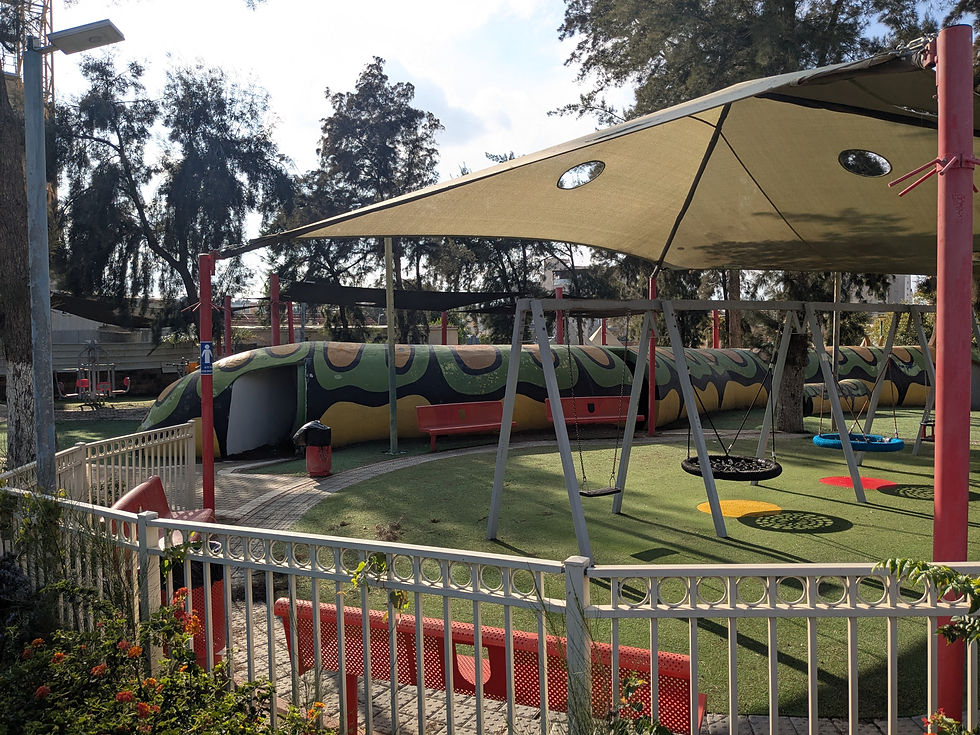
a children’s playground that has what looks like a giant painted concrete caterpillar in the centre of the yard. For all intents and purposes it is exactly that and no doubt something kids like playing in and on. But on further inspection, it also became apparent that this concrete colourful structure is a disguised bomb shelter in the middle of the yard, with thick walls and open doors strategically placed. Not for the first time we realised that kids in this country grow up very differently to where we are from. And that idea was reiterated inside the centre. The Chabad rabbi,

an Israeli native who has lived in Sderot most of his life, told us where he was on October 7, how he and the community lived and survived before and since, and how resilience is so much part of the nature of life in this town. But what resonated most was how blase he was about life in this village. He said that since the late 1990s there has been a barrage of rockets and mortars coming into the community, so much so that the Chanukiah (candelabra) outside the building is made of rocket shells. On the morning of October 7 therefore, they all heard the sirens and saw some activity, but initially at least, dismissed it as yet another rocket attack – nothing out of the ordinary. It was only when the number and intensity of the rockets increased to a level that no one had previously experienced that they realised this was something different. In the meantime, he still came to the synagogue on that day and had tried to have a normal morning until they all realised that something abnormal was going on. As such, he eventually checked his phone on that fateful Shabbat (which is contrary to Jewish law except in life saving circumstances) and then began warning others about what was going on. But his attitude never changed and despite the fact that most of the town was very quickly evacuated, he decided to stay and look after those who couldn’t or wouldn’t leave. He did admit though that he made that decision on his own and on behalf of his community, but that it negatively affected his wife and kids, and that his family, like most in the area, are all still feeling the effects of that day

and the two years since.
From there, although it wasn’t initially part of our itinerary, we drove a little while past some of the Kibbutz names we recognised, to Tkuma, a village in the area that has become synonymous with the aftereffects of October 7. On the outskirts of town is what can only be described as a car graveyard. On the day itself many people abandoned their cars on the sides of the road or were killed in their cars. Some were also assaulted in their cars, and some terrorist vehicles were also intercepted. Almost all of these cars, and many of the burnt out ones as well, are now gathered in a central area, some with the stories of their owners attached to plaques, and others just displayed as they were found, with the bullet holes still very visible and the windows blown out. The police memorial in Sderot didn’t make October 7 feel quite real, but this intimate, heart-wrenching site finally brought it to reality. The extent of the damage to the cars really showed how brutal the attack was, and it made us think – again not for the first time – how intimate some of that brutality was. Many of the people in these cars were killed at close range, and the damage to so many of the cars was total and almost inhuman. How does a person, even one brought up on hatred, kill another human being in such cold blood? The people in these cars never stood a chance. The brutality of this memorial was on very visceral display, and even 10 minutes there was enough to get a real sense of what happened. It also mentally and surely emotionally prepared us for the next site.

The main place that groups, celebrity visitors, politicians and activists get taken to these days is a serenely beautiful site by the forest of Re’im. If not for what happened there, it would be a glorious place for a bushwalk or a picnic – which is what it was used for before – and one can easily imagine how such a site could become the venue for an outdoor gig. In fact, the Nova music festival was never supposed to be at this site just a few kilometres from Gaza. It should have been near Tel Aviv but was moved almost at the last minute because security authorities deemed that a venue next to a major city might be too dangerous. Instead, what could be safer than a clearing in a forest with no one around?!? As it happened, the terrorist organisers who planned the attacks on October 7 knew about the Kibbutz venues in the area and knew about cities like Sderot, but didn’t know about this site. It is very likely therefore that all their Eids came at once when they discovered an Israeli rave in the middle of the forest and saw how unprotected the area was by trees or security. Not only that, but by the time the attack started at around sunrise, most of the partygoers were high and sleep deprived. Thinking clearly was hard for many of them, and yet most of us have heard stories about how some of them managed to escape, hide or think on the run in order to get away.
The site now is essentially a memorial to the victims. Every single person killed there, at a minimum has an individual plaque lovingly made by a local artist, with a photo and a short biography, usually in Hebrew and English. At the base of these plaques are some of their personal effects, from sporting and musical equipment, to photos, toys, candles or quotes. There are other larger plaques around the site too, further explaining some of the stories, and most of the stages, bars and DJ booths that were set up around the site for the dance party, are still there too, preserved as they were left on that day. Slightly further afield are plaques for other victims or hostages who were killed elsewhere, as well as plaques to some of the heroes who survived or helped rescue some of the survivors. Even some of the places where people hid are visible or on display. The result of all these plaques and remnants is an eeriness and even somewhat of an otherworldliness, especially because people walk around the site in almost total silence out of an abundance of respect. What made it even more solemn yet serene was that we were there at around sunset, and the place took on an almost holy glow. We walked around and read about how young most of the victims were, how brutally they were murdered, and how their lives and those of future generations were extinguished in an instant. After some time, we gathered as a group, and one amongst us said that this site has now become Israel’s Auschwitz. Even before that was said, I had made the

comparison in my mind, and afterwards, that is all I could think about. After all, both are in otherwise serenely beautiful locations, both are memorials to the barbaric nature of humanity’s capabilities, and both leave you with a sense of dread about the banality of the human existence. Both also made me feel like there is so much more that I want to achieve in life. As a friend of mine wrote after visiting this site several months ago, ‘what is a Nova anyway? A star that suddenly increases its light tremendously and then fades away. We will never let their light fade away.’
The long drive back to Jerusalem began very solemnly. Everyone took some personal time to process and reflect. But soon enough some quiet Israeli music came over the loudspeakers, and conversation and laughter returned too. The day may have started out not quite as anticipated, but ended in a loving a beautiful manner, with everyone there for each other, allowing us all to take in what we had just seen in the company of loved ones. For many of us that continued back in the city. Whilst we all split off in our own ways for dinner, I don’t think anyone ate on their own. We all went in small groups and just sat with each other enjoying great food and great company. The intimacy of our communal bond allowed us to experience this most harrowing of days with the comfort that we were there together and for each other, and often there is no better feeling.
Day 8 – Tuesday 20 January
Our last full day together began with another fairly long drive, this time to the outskirts of Petach Tikvah. We visited an organisation called Israel Support Bridge, which was set up almost by accident. Very soon after October 7 it was clear that citizens, municipalities, the army and others needed supplies. Not military or specialised equipment, but everyday items like winter coats, sweatshirts, toiletries, medicines, etc.

Some people started buying these products, others started donating them, and soon enough, through a series of coincidences, good old fashioned chutzpah and some planning, an organisation was born, and an unused warehouse was repurposed and donated. That is where we met, in a clearly industrial part of town. The organisation collects donated items, collates and organises them, and then prepares them for distribution. But they do this on the smell of an oily rag as we say, with almost no money or manpower. Donations of items regularly come in, but they struggle to collect the funds required to run the organisation, and there are never enough volunteers to assist. Unfortunately that is very clear. The warehouse is a bit of a shambles, with seemingly no systems or processes in place and very little organisation. Before we even began our task for the day, some of us started to think about how we could improve this place, if we only had a few days rather than a few hours.
In the few hours that we did have, our various tasks were to repack some of the items that had previously been counted but were not properly packed or labelled, or to do a stocktake of other items and to label things properly. Given the extensive task required to get this warehouse into some kind of organised working order, our meagre tasks didn’t generally feel like they were very helpful, but some were clearly more necessary than others. It also didn’t exactly help that the CEO and the few people around didn’t seem very appreciative of our efforts. For the first time all week, despite actually achieving something somewhat useful for a vital organisation, we felt like we were almost a burden rather than a help. It is very clear that people make an organisation, and even in other tasks where we achieved less, we walked away with a better feeling than on this occasion.
But that was a minor complaint at the end of an extraordinary week. Before leaving we had a closing session where everyone shared their thoughts about the

program, including their highlights, lessons and general feelings. Of course for all of us it was impossible to summarise a program of this nature in just a few short sentences or paragraphs without much preparation time. Many of us will be processing for weeks if not months to come. For me, writing about it has been a highly rewarding and cathartic process. But we nonetheless shared our thoughts in the moment, and the overwhelming sentiments were about the opportunities that we were provided with, and the people we did them with. It is almost unfathomable that most of us only met last Monday. The gathering at the airport in Melbourne now feels like a lifetime ago because of the intimacies we had developed and the intense friendships that now felt so genuine and comfortable. We all knew that within hours we would no longer be a group, but it was the group and the people in it that made the experience what it was. The other overwhelming reflection was about how good it was to be in Israel at this time, and to see Israel through the eyes of the people we met. For the first timers it was particularly special, and all of them are staying on for at least a few days to continue their experience, which is wonderful. We all chose to come not on a touring program but on a program where we had the opportunity to give back, but as someone had quipped on the very first day that this program is really just about giving, not giving back. And having the opportunity to give and experience this country in such a way is an opportunity we will all cherish and remember fondly.
-----
After the closing session, our time as a group had ended. Some departed the country or went to visit family, and some began the touring part of their visit. But despite the

official end of the program, most of us gathered back in Jerusalem later that night to spend one last night together. We ended up in the Shuk and then back in the lobby after the couple dates had departed. We also regrouped again for breakfast, but not before a few of us went back to the Old City and the Kotel one last time, as a way for farewelling this country and this city. Through all these opportunities, with a little more time to process and reflect, we discussed what we had seen and done, and what impression this country will leave on us.
Ultimately Israel is an unbelievable country in every sense of that word. It is resilient beyond all measures and portrays a carefree nature even in the middle of a war, or just after, though even a small scratch beyond the surface reveals scars and tensions that are hard to overcome or heal. It is still reeling from a long and arduous war, but the reasons for that war, the continuing loss of Israeli soldiers and the attacks that started it, are of more concern to the majority of citizens than the consequences of their actions, and mostly likely that is fair enough, even if it negatively affects the diaspora. It is also a country that generates and ennobles such generosity, that even a group in their 30s to 50s from the other side of the world can come on a heavily subsidised trip funded largely by caring philanthropic strangers, to contribute and give so freely of their time and talents. But in the end, who got more out of it? The people and the organisations that we helped, or us? In altruistic giving, the giver always gets more out of the experience than the recipient, and that was undoubtedly true in this case. We are all physically, emotionally, spiritually, mentally and communally nourished, and there is no better way to end such an experience.
Comments